
How We Build Equipment That Lasts: Manufacturing Quality
How We Build Equipment That Lasts: Manufacturing Quality
Table of Contents
The Howard Standard
Howard menu boards last 15–20+ years because every unit is built with heavy-gauge structural steel and an industrial powder-coat finish, engineered and assembled entirely in-house. We control the entire process, engineering, fabrication, finishing, and assembly and it shows in the manufacturing quality of every product we ship.
Every Howard menu board ships with 3/16” to 5/16” structural steel rated to 180 MPH wind loads, an industrial powder-coat finish applied at 400°F that lasts 15–20+ years. Every unit is checked against engineering drawings, weld-inspected to AWS D1.1 standards, finish-tested for thickness and adhesion, and powered up. We’ve been doing it this way for 75+ years.
Structural Engineering
Drive-thru menu board structural engineering starts with the right steel specification.
Budget menu boards use thinner steel to cut costs. The difference isn't visible until a storm hits or a permit gets rejected. We start from engineered steel specifications because the structure has to survive decades of wind, weather, and daily use.
What steel thickness does The Howard Company use?
We engineer each structure to the size and wind-load requirements of the specific product using 3/16" to 5/16" structural steel rated up to 180 MPH. Pole thickness alone doesn't determine wind-load capacity; the size and design of the sign play an equally critical role.
Why does pole thickness and design matter?
Under-engineered poles fail permitting, fail in storms, and fail your business. Properly specified steel protects your investment in four ways:
- Permits approved faster: structures engineered to site-specific wind-load requirements pass structural review on the first try across all 50 states.
- Equipment lasts longer: properly specified steel resists bending, vibration, and fatigue over years of outdoor exposure.
- Liability reduced: properly engineered poles prevent structural failures that cause injury, property damage, and lawsuits.
- Right-sized for your application: our engineers match specifications to your structure, avoiding both over-engineering and under-engineering.
- Multi-panel displays supported safely: larger digital menu boards create higher wind loads; our engineering accounts for sign size.
Structural standards we meet
- AASHTO — American Association of State Highway and Transportation Officials
- ASTM International — material standards for structural steel
- ASCE 7 — wind-load design criteria
Surface Protection: Powder Coating
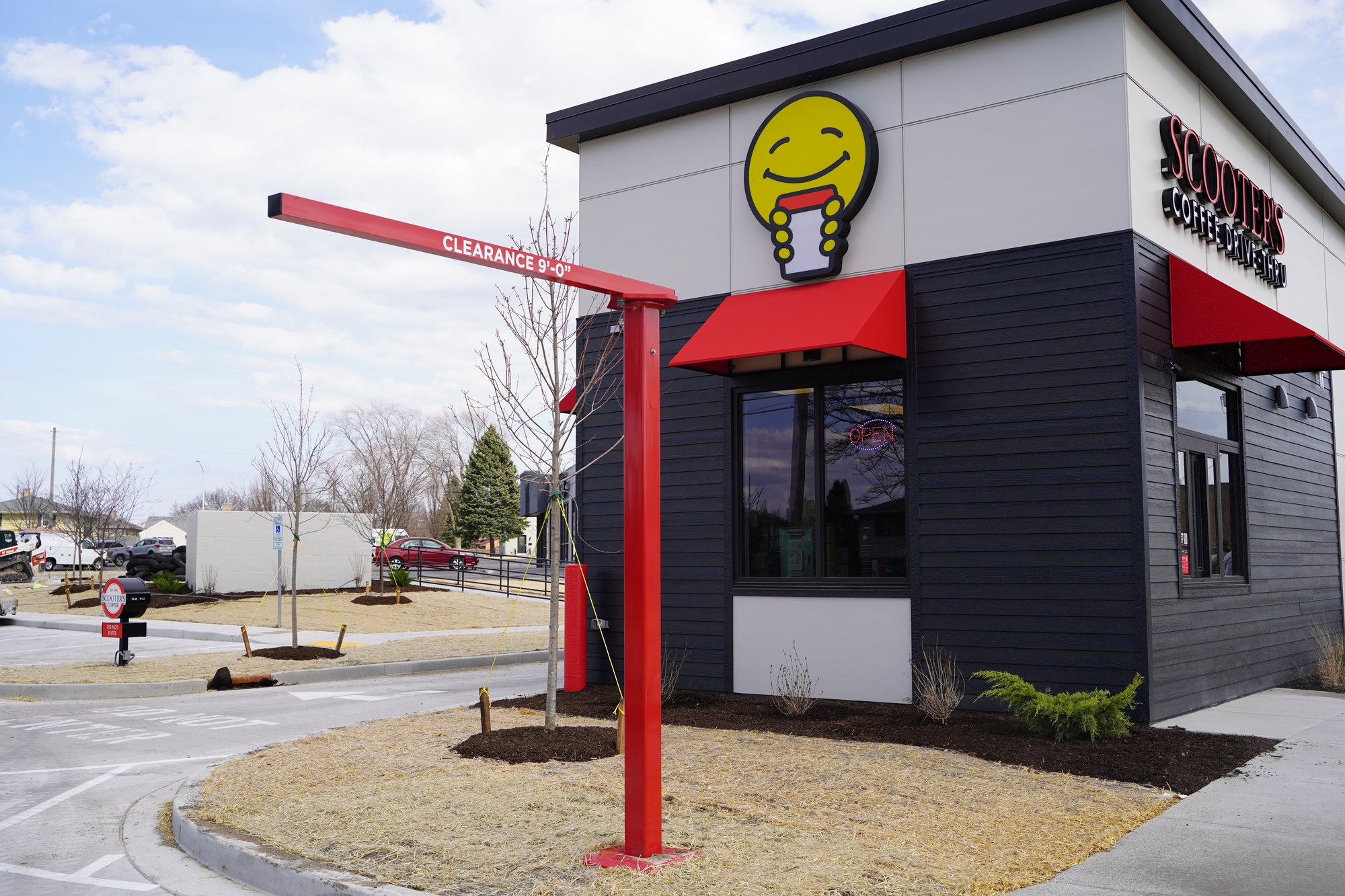
Powder coating is the best finish for outdoor menu boards. It lasts 15–20+ years versus 5–10 for wet paint, resists chips, scratches, UV fading, and corrosion, and needs little maintenance. It's a dry process: electrostatically charged powder bonds to the metal and cures in an oven at 400°F, leaving a thick, uniform protective shell. We powder coat every indoor and outdoor menu board we manufacture.
How does powder coating compare to wet paint?
| Factor | Wet paint | Powder coating |
|---|---|---|
| Typical lifespan | 5–10 years | 15–20+ years |
| Chip & scratch resistance | Scratches and peels with minor contact; exposes bare metal | Absorbs impacts without chipping; 2–3× harder than paint |
| UV & fade resistance | Fades in 2–3 years; chalky residue develops | Color stays true 10+ years; polyester powders resist UV |
| Rust protection | Moisture seeps under edges | Electrostatic bond seals the entire surface; no entry points |
| Finish quality | Potential drips, runs, and thin spots | Uniform thickness on all surfaces |
| VOCs | Yes; hazardous handling | Zero; overspray recyclable |
| Maintenance | Annual touch-ups; full repaint every 5–10 years; rust repair as needed | Wash with soap and water as needed; no repainting or rust repair |
Why this matters for your equipment
A painted menu board needs touch-ups every year and a full repaint every 5–10 years, plus rust repair when moisture gets under chipped edges. A powder-coated board needs soap and water for 15–20 years. The higher upfront cost disappears once you factor in decades of avoided maintenance, and your equipment still looks professional while competitors are scheduling their third repaint.
That's what 75+ years of manufacturing experience looks like. Heavy steel and a 5-year finish doesn't make sense, and neither does thin steel under a 20-year coating. We build both to last.
Welding & Fabrication
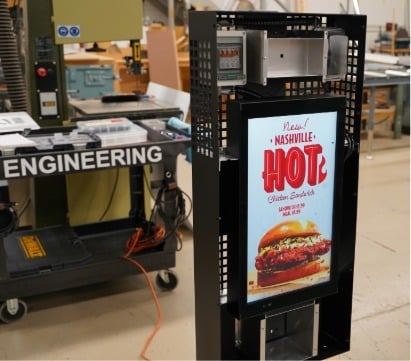
Every Howard menu board structure is welded in-house by our fabrication team, not assembled from bolt-together kits sourced from a catalog. In-house control means we specify the joint design, weld process, and inspection criteria for every unit we ship.
What makes a structural weld different from a cosmetic one?
A cosmetic weld fills a seam and looks clean. A structural weld is a calculated load-bearing joint: penetration depth, heat input, and bead geometry are specified to match the steel grade and the forces the joint must carry. Our welders work to AWS D1.1 (Structural Welding Code — Steel) standards. Joints are visually inspected for porosity, undercut, and incomplete fusion before any unit moves to finishing.
Seam sealing after fabrication
After welding and before powder coating, all seams and joints are sealed to eliminate moisture entry points. Open seams trap water, accelerate rust from the inside out, and eventually compromise structural integrity, none of which is visible from the outside until the damage is done.
Corrosion Protection
Powder coating is the final barrier against corrosion, but how well it bonds to the steel depends almost entirely on what happens before the powder goes on. Surface preparation is the step that separates a finish that lasts two decades from one that starts peeling in five years.
Pre-treatment: what happens before the powder?
Before powder coating, every structure goes through a multi-stage pre-treatment process:
- Cleaning: mill scale, oils, and fabrication residue are removed. Contaminants left on the surface prevent the powder from bonding uniformly.
- Zinc phosphate conversion coating: a chemical conversion layer is applied to the bare metal. Zinc phosphate provides a micro-crystalline surface that dramatically improves powder adhesion and adds a sacrificial corrosion barrier.
- Rinse and dry: residual chemicals are removed and the part is dried before entering the powder booth. Any moisture at this stage causes adhesion failures and blistering.
Fasteners & Hardware
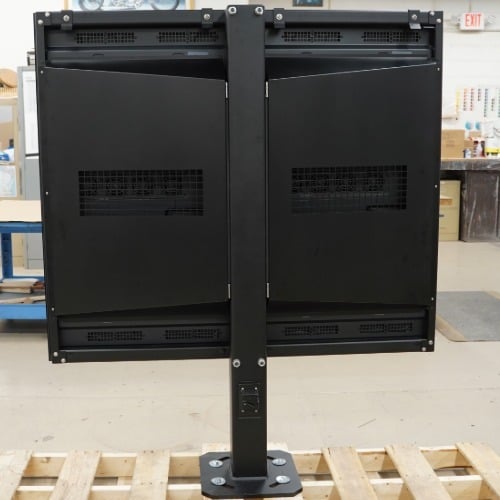
A structure is only as durable as its weakest connection. Corrosion works its way into fasteners first, especially in coastal, high-humidity, or road-salt environments, and corroded fasteners are both a structural risk and a maintenance headache.
Stainless steel vs. zinc-plated fasteners
Zinc-plated fasteners offer basic corrosion protection, adequate for dry indoor applications, marginal for outdoor use, and insufficient in coastal environments. We use stainless steel fasteners (304 or 316 grade, depending on application) for exterior connections. Stainless forms a passive oxide layer that self-repairs when scratched, providing corrosion resistance that holds for the life of the structure.
Tamper resistance
Drive-thru equipment sits in a publicly accessible environment. Exterior fasteners are specified with tamper-resistant drive types where appropriate, reducing the risk of vandalism or unauthorized access to electrical and mounting components.
Weatherproofing & Sealing
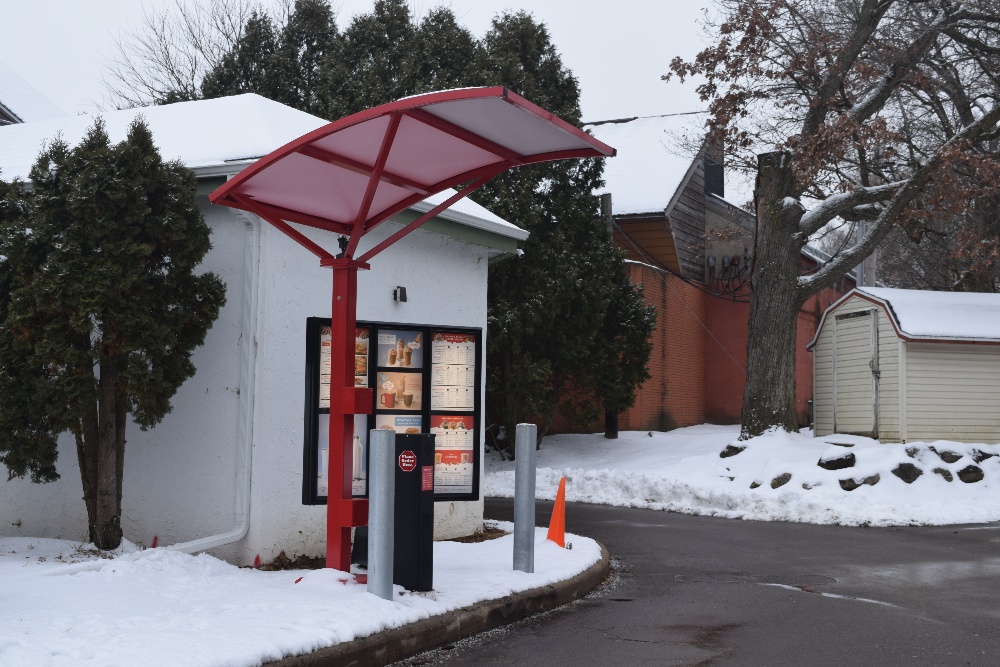
Steel and powder coat handle structural and surface protection. Weatherproofing handles everything water does after it gets past the finish, managing drainage, condensation, and thermal cycling across thousands of heating and cooling cycles over the life of the equipment.
Drainage design
Horizontal surfaces and enclosed cavities that trap standing water are a design flaw, not a weathering issue. We design drainage into the structure: weep holes, drainage channels, and cavity geometry that prevent water from pooling inside poles, frames, or enclosures.
Gaskets and enclosure sealing
Electrical and electronic components housed in outdoor enclosures are protected by compression gaskets at all panel seams and access doors. Component enclosures are rated to NEMA 4 (weatherproof) or NEMA 4X (weatherproof and corrosion-resistant) standards as appropriate for the application.
Thermal cycling
A menu board in the Upper Midwest might swing 120°F between a winter low and a summer high. Joints, seals, and finish materials are selected to handle that range without cracking, delaminating, or opening gaps. The cured powder-coat finish expands and contracts with the steel rather than against it.
Load Testing & Quality Inspection
Engineering specs and material certifications tell you what a structure should do. Inspection and testing tell you what it actually does before it leaves the facility. Our quality process catches dimensional, finish, and structural issues at the source, not on a job site across the country.
Dimensional and weld inspection
Every fabricated structure is checked against engineering drawings for dimensional accuracy and inspected for weld quality before it moves to finishing. Weld inspection covers visual criteria defined in AWS D1.1: surface porosity, undercut depth, overlap, and incomplete fusion.
Finish inspection
After powder coating and cure, finish thickness is measured with a dry film thickness gauge (DFT). Parts with thin spots, holidays (voids), or adhesion failures are stripped and recoated. Color consistency is verified against approved color standards, a critical step when a franchise brand's color is a contractual specification.
Pre-shipment functional check
Complete menu board assemblies are powered up and functionally tested before packing. Display performance, electrical connections, and mounting hardware are verified so that issues found in the facility, where they're fast and inexpensive to fix and don't become field service calls after installation.
That's what separates Howard Company's drive-thru manufacturing quality from vendors who outsource assembly.
Built to last - for real
We still manufacture and supply replacement panels for Arby's drive-thru menu board systems originally installed in the early 1990s. Over 30 years later, the structural frames are still standing.
Published: 6/23/2026
Anyone can sell you drive-thru equipment. The question is whether it's still standing — and still looks professional — in 15 years.
Talk to The Howard Company