
Crest Foods Grocery Digital Signage Solutions
STORES IN ONE ROLLOUT
WEEKS, FIRST ORDER TO LAST STORE LIVE
PERSON RUNS CONTENT FOR ALL NINE STORES
STORES KEPT THEIR ORIGINAL SCREENS
Digital Signage Across Nine Grocery Stores
Crest Foods came to The Howard Company to install digital signage in more of its stores after the supplier behind its first two digital stores went out of business. Seven locations got new displays at the deli and meat counters. The two stores already running screens joined the same content platform instead of being torn out. All nine were finished in about 16 weeks, and one employee now handles content for every location.
Last Updated: 10/30/2026
At a glance
| Customer | Crest Foods, a family owned independent grocer founded in 1946 |
|---|---|
| Market | Oklahoma City metro, ten stores of about 100,000 square feet each |
| Stores in the project | Nine: seven with new displays and two that kept their existing screens |
| Departments | Deli and meat service counters |
| Displays | LG commercial displays, 65 inch and 55 inch, player built in |
| Content | One cloud content platform, run in house by one employee |
| Timeline | About 16 weeks, first order to last store live |
| Partner | The Howard Company: displays, media players, software, installation and support |
| Referral | Associated Wholesale Grocers |
Who is Crest Foods?
Crest Foods is a family owned independent grocer in Oklahoma that brought digital signage to nine of its stores with The Howard Company. It was founded in 1946, is run by the third generation and has ten stores across the Oklahoma City metro.
Its stores run about 100,000 square feet each, with a full deli, bakery, produce and meat department, and a sushi counter.
We are old school grocers, old school family style. So I was kind of surprised the vice president liked it so much. But he loves it and I love it. I think they look great.
How did the project start?
The project grew out of Crest Foods' two newest stores and one executive's reaction to them.
-
How it started. When Crest Foods built its ninth store, Associated Wholesale Grocers recommended digital menu boards for the deli and meat departments. The tenth store was built the same way. The other eight ran printed promotions.
-
Why it spread. A Crest Foods vice president saw the new boards and thought the stores looked cleaner. He wanted every location to match and handed the job to Eric Lollar, Safety Coordinator and Business Operations.
- The catch. The supplier behind the first two stores was going out of business. Eric needed someone to support the existing screens and equip more stores on a short schedule.
THE GOAL
Why Crest Foods added digital signage at the counters
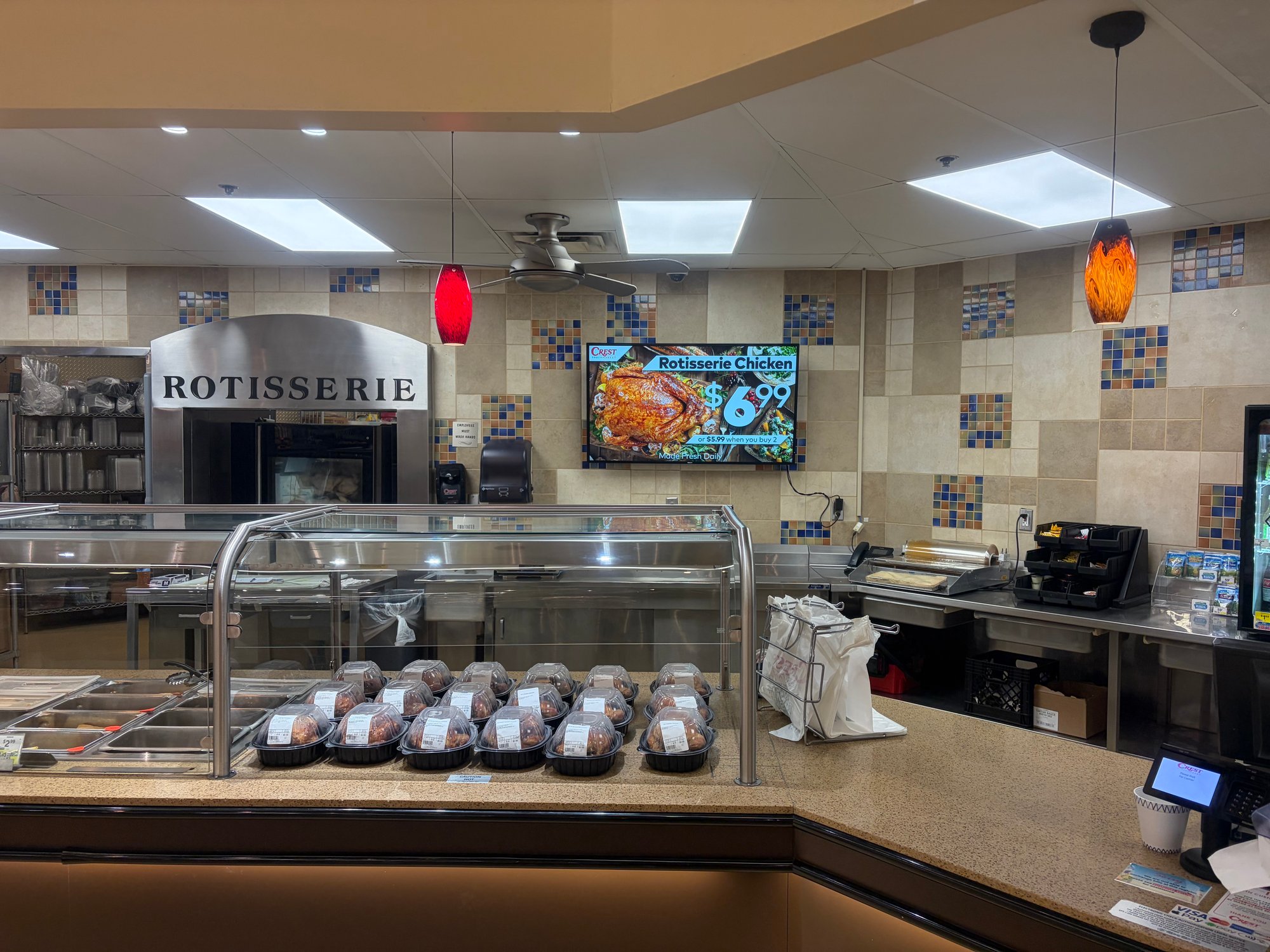
Crest Foods wanted counter promotions that could change often, run on set dates and differ by store, so it worked with The Howard Company to add digital signage at the deli and meat counters.
Vendor advertising revenue
Crest Foods wanted to offer its vendors paid space at the service counters. Selling that space takes placements it can rotate between vendors and schedule to set dates.
Product education at the counters
Eric Lollar makes the case that the deli and meat counters gain more from explaining a product than from discounting it. A customer who understands an item is more likely to buy it. A screen can rotate several of those stories in the same spot.
Operational efficiency
One upload instead of five steps at every store. A printed promotion had to be designed, printed, shipped, hung and taken down, and every one of those needed a person.
Location level control
Crest Foods runs the same promotion in every store, so it needed a way to pull one at a single location without touching the rest. Now that decision sits with the person already scheduling the content.
THE SOLUTION
What did The Howard Company install?
The Howard Company installed new LG commercial displays at seven Crest Foods stores and added media players and software at the two stores that already had screens. All nine run on one content platform.
Seven stores, no screens
New LG commercial displays, 65 inch and 55 inch with the player built in, installed at the deli and meat counters.Two stores, already digital
Existing screens retained. Media players and software added, no new monitors, on the same platform as the other seven.
One cloud platform
All nine locations run from a single content platform, managed in house by one employee.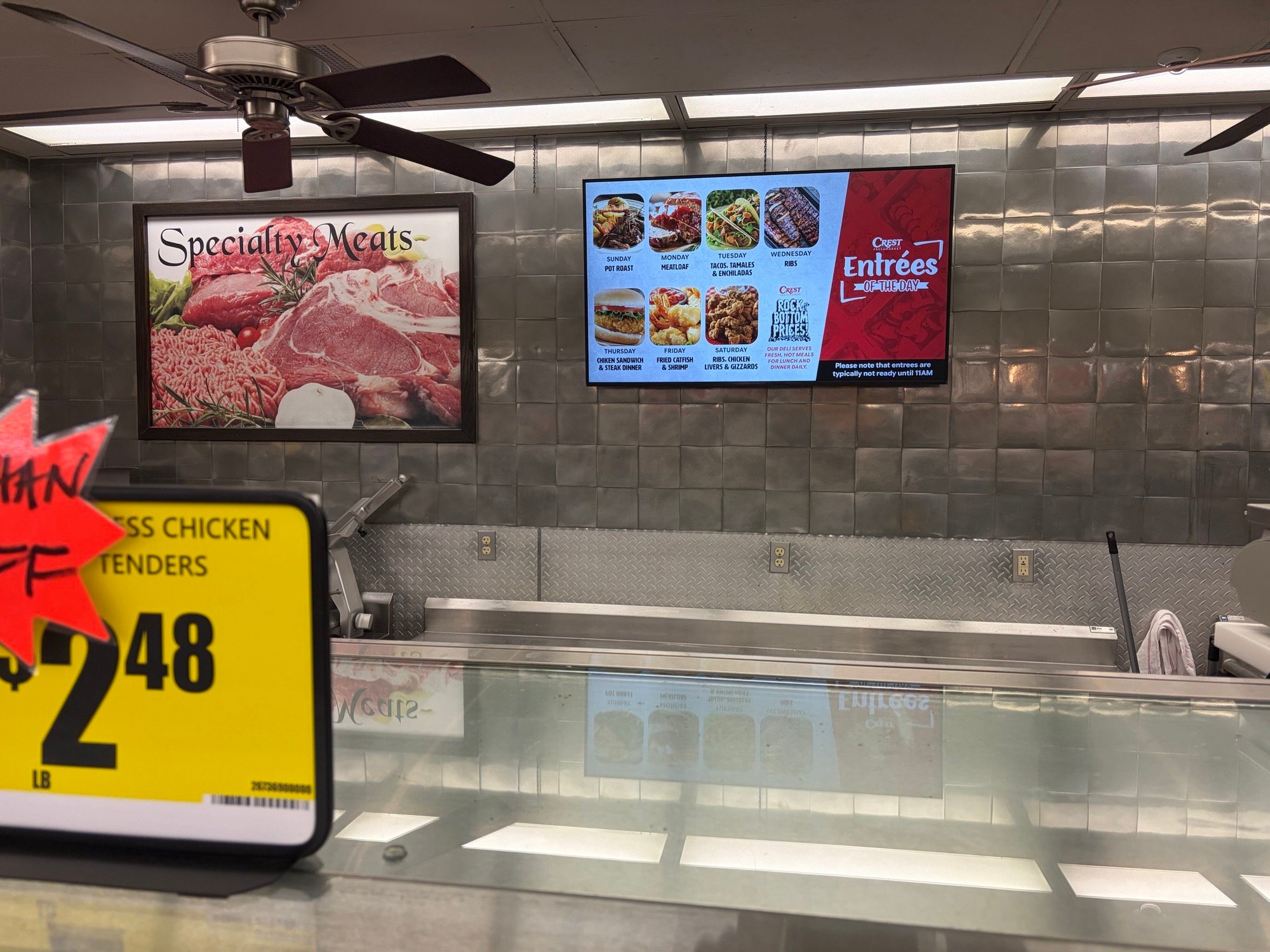
Why the service counters were prioritized
Shoppers keep moving through produce and the bakery aisle. At the deli and meat counters they stop, and a customer holding a number stands there for several minutes, right in front of the products that take the most explaining.Checkout is the other place a shopper stands still, and Crest Foods already had it covered with Grocery TV, a third party network.
By checkout the basket is full and the decisions are made. At the counters the shopper is still deciding, so that is where a screen can change what goes in the cart.
Oh absolutely, yeah.
When asked whether he would recommend the move from printed posters to digital to another AWG member
THE RESULTS
Results: what changed for Crest Foods
The Howard Company gave Crest Foods faster promotion changes and store-by-store control at its counters. Here is how the work changed.
-
01Content updates
Changing a promotion
Result
Those departments no longer print promotional material.
Before
A change took about an hour. Every printed promotion was designed, printed, shipped, hung and taken down at each store.
After
A change takes about five minutes. One upload goes to all nine stores and expires on its own.
-
02Store-level control
Pulling a promotion at one store
Result
When a lower volume store sells out of an advertised item, the ad comes down there in a few seconds.
Before
Whether a promotion came down at one store was up to whoever happened to be in that store.
After
The person scheduling content pulls it for that one store from a desk.
1 / 2
What happened after the last store went live
They ordered more. Three weeks after the last store went live, Crest Foods ordered another display for one of its Oklahoma City stores.
Customers are more attracted to it. They kind of stick around a little longer, looking at it.
On how customers have responded
RETAIL MEDIA
How Crest Foods plans to earn ad revenue from its screens
Crest Foods plans to sell screen time at its deli and meat counters to the brands on its shelves. That ad revenue was the main reason it moved to digital with The Howard Company.
It licensed the advertising software in June 2026 and is setting its prices before it sells any ads.
Why the store is where you reach shoppers
Groceries can be ordered to a car or a doorstep now, so the shopper who walks in is the one you can still reach. Screens at the counters reach them while they wait, and Eric has already noticed the difference.
What screens give a regional grocer
Vendor demand has rarely been the hard part. What was missing was a way to rotate an ad, schedule it and pull it at one store. Screens handle all three, the same way a national retail media network does.
Rotation
Several vendors share one screen position instead of competing for limited wall space.
Scheduling
A campaign starts and ends on set dates without anyone driving to a store.
Placement assurance
What a vendor pays for is an ad that was not running in a store where the product had sold out.
What is left to figure out: pricing
- Price it too high and the space does not sell.
- Price it too low and it is hard to raise later.
- Who sets it: some grocers work it out themselves, which is what Crest Foods did. Others hand it to a retail media service.
Tip: plan the ad program while the installation is still being scoped. Screen count, placement and which departments go first all change what the space is worth.
Want to know what your screens could earn?
Our in-store retail media guide breaks down how the model works and gives zone-by-zone rate estimates for your stores.
WHY US?
Why did Crest Foods choose The Howard Company?
A referral from inside the grocery industry
Eric Lollar told Jessica Magnussen at Associated Wholesale Grocers that he needed a supplier on short notice, and she introduced him to us. AWG is owned by more than 1,100 independent member retailers.
One number to call
Displays, media players, content management software, installation and ongoing support all come from one company. If a screen stops working, you make one call. We figure out whether it is the monitor, the software or the install.
No rip and replace
Two locations kept their existing displays and joined the same platform as the other seven, for the cost of players and software instead of new monitors.
We settled the network before we sold anything
Crest Foods wanted to run the screens over store WiFi. We flagged the risk in writing, because a router reset can interrupt playback, then worked through the specifications with their IT contact. No site was surveyed until that was settled, and the final scope supports the wireless setup they wanted.
Frequently Asked Questions
Common questions from grocers planning digital signage, answered with what we learned at Crest Foods.
How much does digital signage cost for a grocery store?
Installed cost for Crest Foods ran from about $3,300 to about $11,900 per store. The Howard Company equipped nine locations, and the spread came from how many displays each service counter needed, not from different pricing. Budget by display count, not store size. Software and support are billed separately, on a recurring basis. For a starting number, try the indoor menu board price calculator.
Can you add digital signage without replacing the screens you already have?
Yes, if the screens are still in good shape. At two Crest Foods stores, The Howard Company kept the existing screens and added media players and software, so those stores run on the same platform as the other seven. They had no new monitors to buy.
Can in-store digital signage run on WiFi?
It can, but The Howard Company's install team recommends hardwired cabling because a router reset can interrupt playback. Crest Foods wanted WiFi. We flagged the risk in writing and worked through the specs with their IT contact before any site survey, and the final scope supports the wireless setup.
What does a store need before digital signage is installed?
A store needs power, a network path and a firewall exception before installation. The Howard Company gives you the specifications for all three before anyone schedules a survey.
-
Power. Every mounted display needs an outlet behind it, and one 120 volt circuit will usually serve two displays. Your electrician goes before our installer.
-
Network. A wired or wireless connection to each player. See the WiFi question above.
-
Firewall. The media players pull content from the cloud, so your security provider has to whitelist the addresses we supply.
How long does a multi-store digital signage rollout take?
The Crest Foods rollout with The Howard Company took about 16 weeks for nine stores, from first order to last store live. Power set the pace. Mounting displays before the wire was run cost time at several stores, so line up your electrician before installers are scheduled.
Can one person manage digital signage across multiple stores?
Yes, and you do not need an IT department. One Crest Foods employee runs content for all nine stores on the platform The Howard Company set up, and his background is in print, not IT. You supply the artwork, we build the layouts and we train your staff to schedule and update from there.
Which grocery departments should get digital signage first?
Start where shoppers stand still and need information to decide. With The Howard Company, Crest Foods started at the deli and meat counters, where the wait is longest and the products need the most explaining. It is now looking at produce, dairy, frozen and health and beauty.
Talk to a Grocery Signage Specialist
If you run a grocery store and want promotions you can change, schedule and pull from one desk, The Howard Company has done it before. We handle the hardware, software, installation, training and support with one team.