
Your drive-thru generates 70–80% of your revenue. The decision about how AI transforms it shouldn't be buried in an IT backlog.
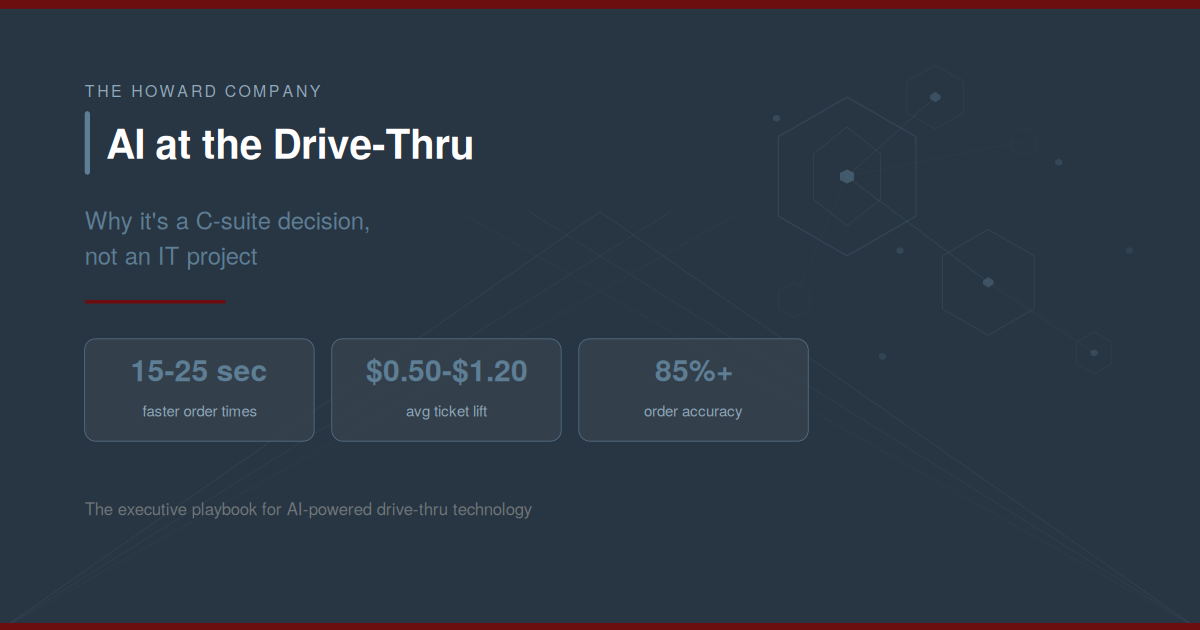
Your drive-thru generates 70–80% of your revenue. The decision about how AI transforms it shouldn't be buried in an IT backlog.
AI-powered ordering at the drive-thru is no longer a pilot-stage curiosity. Major QSR brands are deploying it at scale, publishing results, and pulling ahead of competitors still debating whether to test it. But the brands seeing the strongest outcomes share one thing in common: the decision to adopt was owned by operations leadership or the executive team — not delegated as a technology project.
Here's why that distinction matters, and what executives evaluating drive-thru AI should actually focus on.
This Isn't a Tech Upgrade — It's a Strategic Repositioning
When AI takes or assists with drive-thru orders, it doesn't just change a workflow. It touches:
- Brand perception — For most customers, the drive-thru voice is your brand. AI changes that interaction at a fundamental level.
- Unit economics — Upsell rates, speed of service, labor allocation, and order accuracy all shift at once.
- Franchise relationships — Mandating or recommending AI technology affects franchisee investment, training requirements, and buy-in timelines.
- Competitive positioning — The window for differentiation is narrowing as early movers lock in advantages.
These are boardroom-level decisions with P&L, brand, and growth implications. Treating them as an IT procurement exercise undervalues the opportunity — and increases the risk of a misaligned deployment.
The ROI Levers That Actually Matter
AI vendors will pitch dozens of metrics. Here are the four that consistently show up in real-world operator results:
Speed of service: AI ordering systems are reducing average order times by 15–25 seconds per transaction. For a location running 200+ drive-thru orders daily, that translates to 8–14 additional cars per hour at peak — a 10–20% throughput gain.
Average ticket lift: AI never forgets to suggest a drink with a combo or mention a limited-time offer. Published deployment data shows $0.50–$1.20 in average ticket lift per transaction. At 200 daily orders, that's $36,500–$87,600 per location per year.
Order accuracy: Mis-heard or mis-keyed orders cost operators an estimated 2–5% of revenue through remakes, waste, and customer dissatisfaction. Top-tier AI systems now hit 85%+ autonomous accuracy, with hybrid models (AI + human backup) exceeding 95%.
Upsell consistency: Human employees attempt upsells inconsistently — especially during peak rushes. AI maintains a 100% attempt rate, driving 2–4% attachment rate increases across the board.
The Angle Most Operators Are Missing: Listen-Only Mode
Here's something worth knowing: you don't have to let AI take orders on day one.
One of the most compelling deployment models gaining traction is "listen-only" mode. The AI monitors drive-thru conversations in real time without interacting with the customer. No risk, no customer-facing changes — but significant operational value:
- Employee coaching — The AI identifies missed upsell opportunities, greeting inconsistencies, and order-taking inefficiencies across every transaction. Managers get data-driven coaching insights without standing at the window.
- Operational benchmarking — Compare speed, accuracy, and upsell rates across locations, shifts, and individual employees using data that wasn't previously capturable.
- Menu intelligence — Learn what customers are actually asking for, including items not on the menu, common modifications, and peak-period ordering patterns.
- Risk-free acclimation — When you're ready to activate autonomous ordering, the system already knows your menu, your customers' speech patterns, and your operational rhythms. The transition is seamless.
Brands starting with listen-only mode report higher franchisee adoption rates and smoother full-deployment rollouts. It reframes the internal conversation from "we're replacing employees" to "we're giving your team a performance coach."
What Gets This Wrong
The most common missteps we see from operators evaluating drive-thru AI:
- Treating it as a standalone purchase. AI ordering connects to your menu boards, POS, kitchen display, signage, and speaker hardware. Evaluating it in isolation creates integration headaches.
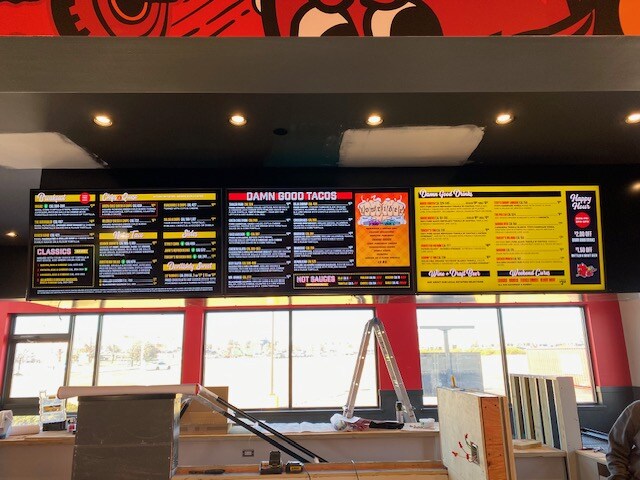
- Ignoring the physical environment. AI performance depends on speaker quality, microphone placement, ambient noise, and menu board clarity. Great software in a dated drive-thru lane will underperform.
- Skipping the franchise conversation. Technology mandates without operator input create resistance. The best rollouts involve franchisee advisory councils early and offer phased adoption paths.
- Chasing features over fundamentals. Multi-language support and loyalty integration matter — but first: can the AI accurately take a standard order during a lunch rush in a noisy drive-thru? If the answer isn't confident, features are premature.
The Bottom Line
AI at the drive-thru is moving from "interesting" to "essential" faster than most industry timelines predicted. The decisions being made right now — about vendors, deployment models, infrastructure readiness, and organizational alignment — will determine which brands lead and which brands scramble to catch up.
These are not IT decisions. They're growth decisions, brand decisions, and operations decisions that deserve executive attention.
Want the full framework? We've published AI at the Drive-Thru: The Executive's Playbook for Getting It Right — a comprehensive guide covering ROI modeling, a vendor evaluation checklist, and a phased deployment framework. Download the playbook →
The Howard Company engineers drive-thru environments — from menu boards and speaker systems to digital signage, kiosks, and AI-integrated ordering ecosystems. We build the physical and digital infrastructure that makes AI work in the real world. Learn more at howardcompany.com


SHARE